


18 May How Can Failing Expansion Joints Compromise the Structural Integrity of Your Parking Garage?
Parking garages are engineered to handle tremendous stress. Thousands of vehicles roll through them daily, temperatures swing from freezing winters to blistering summers, and moisture finds every possible path into the structure. At the center of it all, expansion joints serve as the unsung heroes of concrete construction. When they begin to fail, the consequences ripple through the entire structure in ways that most property owners never see coming until the damage is already expensive.
If you manage a commercial property in Indianapolis or anywhere across Indiana, understanding how expansion joint failure develops, and what it costs you when ignored, is one of the most important things you can do to protect your investment.
What Are Expansion Joints and Why Do They Matter So Much?
Expansion joints are intentional gaps built into concrete structures to allow for natural movement. Concrete expands in heat and contracts in cold, and without these joints, the slab itself would crack unpredictably under that stress. In a parking garage, these joints run horizontally across decks, vertically along walls, and at transitions between structural sections.
The joint itself is typically filled or covered with a flexible sealant or a mechanical assembly designed to compress and expand without breaking the seal. That seal does two critical jobs: it accommodates movement, and it keeps water out. When the seal is working correctly, the structure breathes. When it fails, water enters, and water is the single most destructive force a concrete parking structure will ever face.
Structural joint maintenance is not optional in a climate like Indiana’s. The freeze-thaw cycle alone subjects these joints to enormous repeated stress. Water infiltrates a compromised joint, freezes, expands, and physically forces the concrete apart. Do that hundreds of times over a few seasons, and what started as a hairline issue becomes a structural concern.
What Are the Sealant Failure Symptoms You Should Never Ignore?
Knowing what to look for is half the battle. Sealant failure symptoms often develop gradually, which is exactly why so many property owners miss them until the damage has already spread.
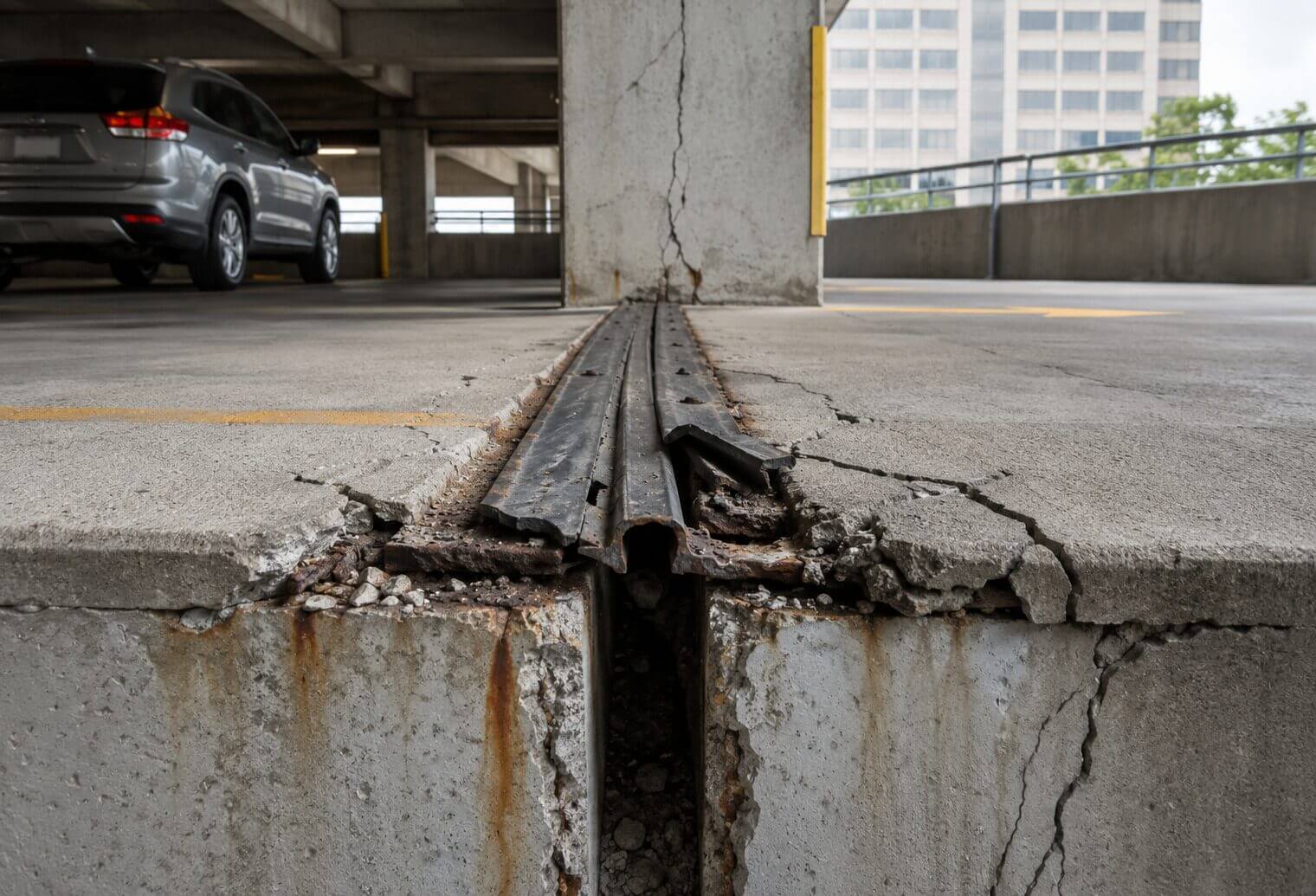
Visible cracking or separation along the joint face is usually the first sign. A properly functioning sealant will flex and return to shape. Once it has lost elasticity, it begins to pull away from the concrete on either side, leaving a gap that channels water directly into the structure. You may notice dark staining along joint lines, which is a sign that water has been moving through regularly.
Efflorescence, that chalky white residue you sometimes see on concrete surfaces, is another indicator. It forms when water carries dissolved salts through the concrete and deposits them on the surface as it evaporates. If you are seeing efflorescence near joints, water infiltration is already happening.
Rust stains are more serious. They signal that water has reached the rebar inside the slab. Reinforcing steel begins to corrode when exposed to moisture, and as it rusts, it expands, causing the concrete around it to crack and spall. By the time rust stains appear on a parking deck surface, the repair scope has already grown significantly.
In Indiana, where road salt is used heavily during winter months, chloride-laden water is an especially aggressive threat. Salt lowers the freezing point of water and accelerates corrosion in reinforcing steel. A compromised expansion joint in an Indianapolis parking garage during a salt-heavy winter is a fast track to serious structural deterioration.
How Does Water Infiltration Lead to Structural Damage?
The path from a failing expansion joint to genuine structural compromise is not a long one. It begins the moment water finds a consistent entry point and is given time to work.
Water that enters through a failed joint migrates through the slab by following the path of least resistance. It collects in voids, it saturates the concrete matrix, and it finds the rebar. Once rebar begins to corrode, the bond between steel and concrete weakens. That bond is what gives reinforced concrete its tensile strength. Without it, the slab loses its ability to handle load the way it was designed to.
Delamination is a common result. This is where layers of concrete separate from one another, often appearing as hollow-sounding areas when tapped. Delaminated sections are structurally unreliable and, in a high-traffic environment like a parking garage, a safety hazard.
Spalling, where chunks of concrete break away from the surface, is both a functional and liability problem. In a garage where people walk and vehicles drive, falling or loose concrete creates serious risk. Beyond the immediate safety concern, spalling exposes more rebar to moisture, accelerating the deterioration cycle.
Parking garage waterproofing systems are designed to intercept water before it reaches this stage. But waterproofing is only as effective as the joints it relies on. If the expansion joints are not sealed properly, no surface coating or membrane will compensate for the constant water entry at those weak points. The two systems work together, and neglecting one undermines the other.
Why Is Commercial Expansion Joint Repair a Specialized Service?
Commercial expansion joint repair in Indianapolis and across Indiana is not a job for general maintenance staff or a crew with a caulk gun. These repairs require an understanding of joint design, appropriate material selection, surface preparation standards, and installation technique.
The wrong sealant installed in a joint that experiences significant movement will fail quickly, sometimes within a single season. Materials must be matched to the specific movement characteristics of the joint, the exposure conditions, and the traffic load above. A rooftop parking deck in Indianapolis sees different thermal cycling than an underground level protected from direct sun. Each situation calls for a specific approach.
Surface preparation is equally critical. Sealant adhesion depends entirely on a clean, sound substrate. Failing to remove deteriorated material, contaminants, or moisture before installation is one of the most common reasons repair attempts fail prematurely. Professional concrete repair contractors understand that preparation often takes longer than the installation itself, and they account for that in their process.
Mechanical joint systems, which use cover plates or nosing assemblies rather than sealant alone, require even more precision. These systems must be anchored properly, allow for the expected range of movement, and be waterproof at all transition points. When these systems are installed or maintained incorrectly, they can actually concentrate stress at the joint edges, accelerating adjacent concrete damage.
Parking garage waterproofing work performed at the same time as joint repair is almost always the most efficient approach. Mobilizing for one repair while addressing the other saves cost, reduces disruption to tenants and users, and ensures that the entire envelope is addressed cohesively rather than piecemeal.
What Is the Cost of Waiting on Structural Joint Maintenance?
Deferred maintenance is one of the most expensive decisions a property owner can make. A failed expansion joint that costs a few thousand dollars to address today can require a six-figure repair if ignored for a few seasons.
When spalling spreads, rebar corrosion advances, and delamination grows, the scope of concrete repair expands dramatically. In severe cases, structural members may require replacement or significant reinforcement. Parking garages that reach this stage often face extended closure periods, which creates lost revenue on top of the repair cost itself.
In Indiana, local building codes and liability standards mean that ignoring visible structural deterioration is not simply a maintenance choice. It is a risk management issue. If a piece of spalled concrete injures a pedestrian, or if a structural inspection flags a compromised deck, the consequences extend well beyond repair bills.
Proactive structural joint maintenance, inspected and serviced on a regular schedule, keeps repair costs predictable and manageable. It extends the service life of the garage, protects tenants and visitors, and preserves the long-term value of the asset.
Conclusion
Expansion joints are small in scale but enormous in consequence. For commercial property owners in Indianapolis and across Indiana, understanding how sealant failure develops, recognizing the symptoms early, and partnering with qualified contractors for commercial expansion joint repair is the most reliable way to protect a parking structure from the inside out. The cost of prevention is always less than the cost of neglect.
Need a Maintenance & Repair Contractor in Indianapolis, IN?
Here at Knauss Property Services, LLC, we understand the critical role regular property inspections play in maintaining your commercial space. Our expert team is dedicated to ensuring your property not only meets safety and compliance standards but also operates at peak efficiency. Don’t wait for minor issues to escalate into costly problems—reach out to us today to schedule a comprehensive inspection. Let us help you safeguard your investment, enhance operational efficiency, and preserve the value of your commercial property.