


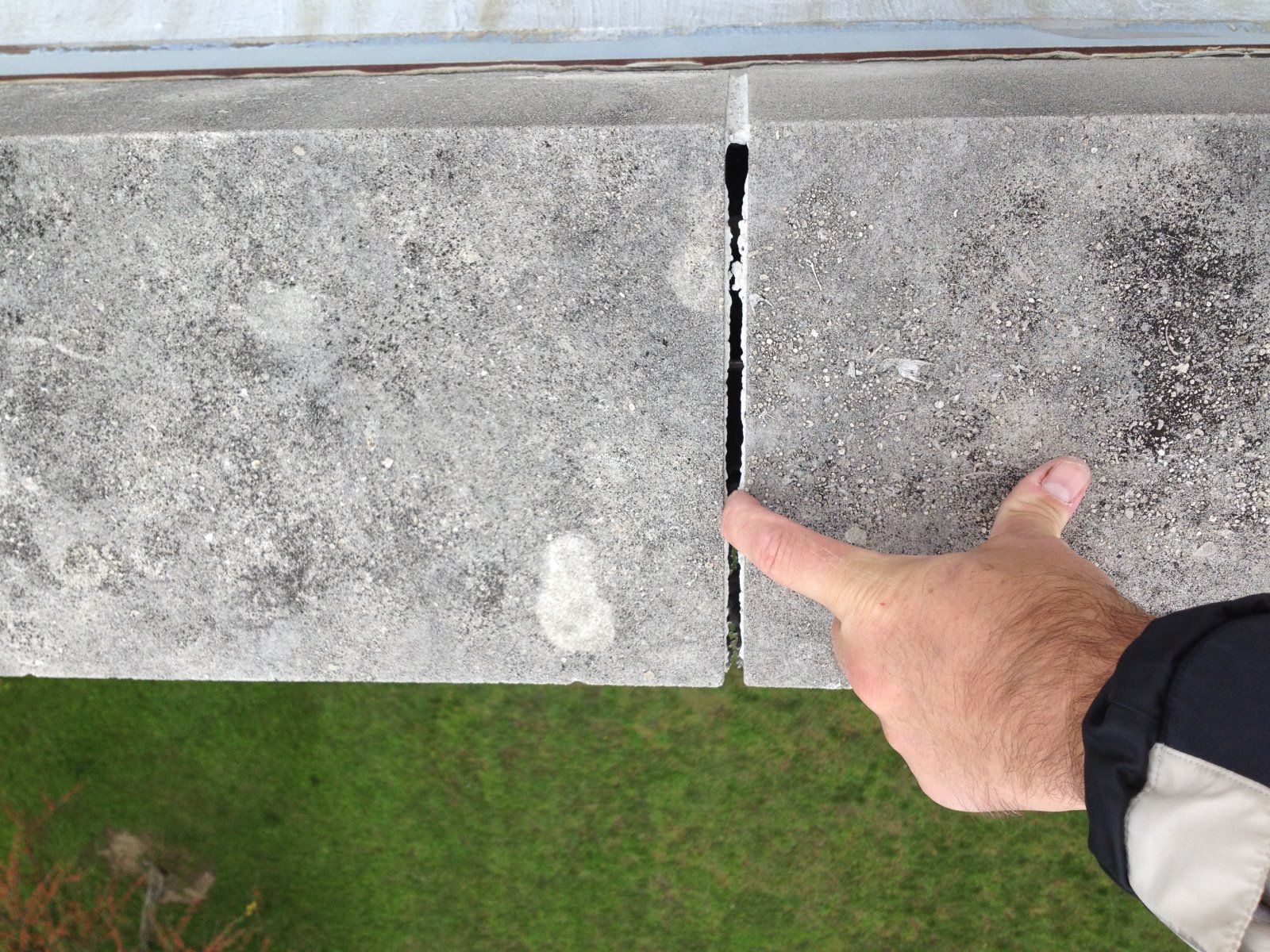
28 Aug Recognizing Expansion Joint Failure Before Water Damage Strikes Your Commercial Structure
Expansion joints are easy to overlook until water begins showing up where it does not belong. For commercial property owners and facility managers in Indianapolis, temperature swings, seasonal precipitation, freezing conditions, and repeated building movement can gradually turn a deteriorated joint into a pathway for moisture.
Quick answer: Expansion joint failure often shows up before major water damage occurs. Cracked or separated sealant, loose joint covers, staining, damp interior surfaces, rust, widening gaps, and recurring leaks near joint locations can all indicate trouble. Identifying these conditions early gives commercial property owners an opportunity to address the joint before moisture damages insulation, finishes, structural components, or occupied spaces.
What local property owners should know
- Expansion joints are designed to accommodate movement, but their sealants, membranes, covers, and related waterproofing components can deteriorate over time.
- Indianapolis properties experience significant seasonal temperature variation, which can repeatedly expand and contract exterior building materials.
- Rain, snow, and freeze conditions in Marion County can expose already weakened joints to moisture infiltration.
- A leak appearing inside the building may originate higher or farther away along an expansion joint than the visible water stain suggests.
- Routine exterior inspections can reveal joint deterioration before an active interior leak becomes obvious.
Why Expansion Joint Failure Matters for Indianapolis Commercial Buildings
Expansion joint failure matters locally because Indianapolis commercial buildings experience repeated temperature changes and substantial annual precipitation, creating ongoing movement and moisture exposure at vulnerable exterior joints. Once a joint can no longer maintain a weather-resistant seal, water can move behind exterior materials and remain concealed until damage becomes much more noticeable.
National Weather Service 1991-2020 climate normals for the area report about 43.63 inches of annual precipitation. The same climate records show average freezing conditions extending from fall into spring, with the average first freeze occurring in late October and the average last freeze in April.
That combination can be demanding on building-envelope components. Commercial properties around Downtown, Castleton, Park 100, the airport area, and major I-65, I-70, and I-465 corridors may include large wall assemblies, parking structures, concrete surfaces, masonry, and other systems containing joints that must continue moving while resisting water.
Knauss Property Services, LLC helps commercial property stakeholders evaluate building-envelope concerns. After identifying a potential expansion-joint problem, we can focus on the conditions contributing to water intrusion rather than treating an interior stain as the entire problem.
Local Data and Field Conditions That Affect Expansion Joints
Indianapolis expansion joints are exposed to a climate that regularly combines precipitation, summer heat, winter freezing, and seasonal temperature changes. These conditions do not automatically cause a joint to fail, but they can increase the importance of proper installation, compatible materials, routine inspection, and timely maintenance.
The National Weather Service lists normal summer highs in the 80s and winter temperatures that routinely fall below freezing. Exterior walls, concrete decks, masonry sections, roofs, and adjoining materials respond differently to those changes.
Movement is exactly why expansion joints exist. Problems develop when components intended to accommodate that movement become brittle, detached, compressed, punctured, deteriorated, or otherwise unable to maintain continuity.
Water then gains an entry point.
How Failed Expansion Joints Can Affect a Commercial Property
A failed expansion joint can allow water to migrate beyond the visible joint and damage multiple layers of a commercial building. Depending on the location and assembly, moisture may affect interior finishes, insulation, masonry, concrete, metal components, ceilings, walls, or tenant spaces before the source is correctly identified.
For an occupied property in Indianapolis, the consequences can extend beyond the repair itself. Water intrusion may interfere with tenants, inventory, equipment, customer areas, or normal facility operations.
Persistent moisture can also make troubleshooting harder. Water may travel behind cladding or along structural components before becoming visible indoors. That is why simply patching the location of a ceiling stain may not stop the underlying leak.
Warning Signs of Expansion Joint Failure
The most useful warning signs of expansion joint failure are visible deterioration, abnormal movement, and moisture appearing near or below the joint assembly. Property managers should pay particular attention after heavy rain, winter weather, or major seasonal temperature changes.
Watch for:
- Sealant that is cracked, split, hardened, or pulling away from the sides of the joint.
- Gaps that appear wider, narrower, or less uniform than surrounding sections.
- Joint covers that are loose, bent, displaced, or missing fasteners.
- Water stains on ceilings or walls close to known expansion-joint locations.
- Damp areas that repeatedly return after rain or melting snow.
- Rust staining or corrosion around metal joint components.
- Efflorescence, discoloration, or deterioration on adjacent masonry or concrete.
- Previous patching that is cracking or separating from the original assembly.
One symptom does not always prove that the expansion joint is the source. A pattern of joint deterioration and recurring moisture, however, is a strong reason for closer evaluation.
When Should an Indianapolis Property Manager Call a Professional?
A professional evaluation is appropriate when an expansion joint has visible separation, recurring leakage, damaged components, or deterioration that cannot be safely inspected from the ground. Commercial building envelopes can involve elevated walls, concealed waterproofing, multiple adjoining systems, and water paths that are difficult to diagnose without appropriate access and experience.
Facility personnel can safely document visible changes from accessible locations. Photographing the same joint periodically can also help identify increasing separation or deterioration.
DIY work should stop when inspection requires roof-edge access, lifts, ladders beyond routine safe facility use, removal of exterior components, or opening the building envelope.
Recurring leaks deserve particular attention. If the same interior area becomes wet repeatedly despite previous patching, the visible interior symptom may not be the actual entry point.
Common Local Causes of Expansion Joint Problems
Common expansion joint problems around Indianapolis typically involve material aging, repeated movement, water exposure, installation deficiencies, or damage to components surrounding the joint. More than one factor can be present at the same time.
1. Repeated thermal movement
Hot summer surfaces followed by cold winter conditions cause building materials to expand and contract. Joint systems must accommodate this movement without losing adhesion or waterproofing continuity.
2. Aging sealant
Sealants do not remain unchanged indefinitely. Weather exposure and movement can eventually cause cracking, hardening, loss of adhesion, or cohesive failure.
3. Freeze and moisture exposure
Water entering small openings can become more problematic during periods of freezing weather. Existing cracks and deteriorated materials should be addressed before winter conditions make inspection and repair more difficult.
4. Movement between adjoining building sections
Expansion joints are often placed where different portions of a building or structure need to move independently. If the joint system cannot accommodate that movement, visible distress may develop.
5. Improper previous repairs
Applying new material over deteriorated or incompatible material may hide a problem temporarily without restoring the joint system.
How Routine Maintenance Can Reduce Expansion Joint Problems
Routine inspection and timely maintenance can help identify deteriorating expansion joints before they develop into larger water-management problems. Indianapolis property managers should include accessible exterior joints in regular building-envelope inspections, particularly around seasonal transitions.
A practical schedule includes visual checks in spring after winter weather and again before colder fall conditions arrive. Additional inspections can be useful after severe storms or when a previously dry interior area suddenly develops staining.
Property staff can look for obvious cracks, loose covers, displaced components, or moisture. Repairs involving sealant selection, joint preparation, waterproofing membranes, elevated access, or extensive deterioration are better evaluated professionally.
Maintenance is most effective when the entire joint condition is considered instead of repeatedly covering one visible crack.
What Results Should You Expect From Expansion Joint Repairs?
Proper expansion joint repair should restore the joint’s ability to accommodate expected movement while improving resistance to water intrusion at the repaired location. The exact repair method depends on the joint design, surrounding materials, deterioration, accessibility, and whether hidden damage has already occurred.
Some conditions may require removal and replacement of failed sealant. Others can involve repair or replacement of joint covers, membranes, transition materials, or adjacent waterproofing components.
A useful inspection should also consider where the water is entering, how the joint is moving, and whether nearby envelope components contribute to the problem.
Common Expansion Joint Repair Mistakes
The most common mistakes involve treating the visible symptom without addressing the failed joint condition responsible for allowing water into the building. That approach can lead to recurring leaks and repeated repair expenses.
Mistake: Sealing only the interior water stain.
Consequence: Water may continue entering through the exterior assembly.
Better approach: Trace moisture back toward the likely exterior entry location.
Mistake: Applying sealant directly over failed material.
Consequence: The new material may not adhere or move correctly.
Better approach: Evaluate preparation, joint geometry, and material compatibility before repair.
Mistake: Waiting until active leaking becomes severe.
Consequence: Hidden materials may remain exposed to moisture for longer.
Better approach: Investigate visible joint deterioration before interior water damage appears.
Mistake: Assuming every leak directly below a joint started at that exact point.
Consequence: The wrong area may be repaired.
Better approach: Evaluate the surrounding building envelope and possible water path.
A Common Indianapolis Commercial Property Scenario
A common local scenario begins with a small exterior joint defect that produces an intermittent interior leak only during certain weather conditions. A facility manager may notice a ceiling stain after wind-driven rain, but the area dries and appears normal again.
Months later, the stain returns.
Because water can travel within the building envelope, replacing a ceiling tile or applying interior sealant may not solve the problem. An exterior evaluation may reveal separated sealant, deteriorated joint material, or another opening along the joint assembly.
This is not a case study of a specific Knauss Property Services, LLC project. It is an example of the type of progression commercial property teams should watch for.
Related Service Solutions
Expansion-joint concerns are best addressed through inspection, diagnosis, appropriate joint repair, and attention to related waterproofing conditions. The correct solution should respond to the actual failure rather than simply cover the most visible symptom.
Our approach can include evaluating the joint area, identifying visible deterioration, considering likely water-entry paths, and determining whether repair or broader building-envelope work may be appropriate.
Request an expansion joint or building-envelope inspection
Comparing Monitoring, Repair, and Professional Evaluation
The right response depends on whether the joint is intact, visibly deteriorating, or already associated with active water intrusion. Minor observations can be documented and monitored, while separated materials and recurring leaks deserve more direct attention.
| Option | Best Used When | Main Limitation |
|---|---|---|
| Visual monitoring | Joint appears intact and no leakage is present | Does not correct deterioration |
| Maintenance repair | Localized joint materials have clearly deteriorated | May not address concealed problems |
| Professional evaluation | Water intrusion recurs or the source is uncertain | Requires access and investigation |
| Broader envelope repair | Joint failure involves adjoining waterproofing or building materials | Scope depends on actual conditions |
Commercial Service Areas Around Indianapolis
Commercial property owners throughout Indianapolis and surrounding Marion County communities can encounter similar expansion-joint and water-intrusion concerns. Properties in areas such as Lawrence, Speedway, and Beech Grove experience the same regional cycles of heat, precipitation, and freezing weather.
The appropriate inspection and repair strategy still depends on the individual structure, joint design, and condition.
What Does It Cost to Ignore Expansion Joint Failure?
Ignoring a deteriorated expansion joint can turn a relatively localized exterior defect into a broader moisture problem involving interior materials, operations, and additional repair work. The longer water has a pathway into a commercial structure, the more opportunity it has to reach areas that were not originally damaged.
For Indianapolis businesses, delayed investigation can also mean addressing leaks during winter conditions or while tenant and customer spaces are actively affected.
Early attention does not guarantee that hidden damage has been avoided, but it gives property managers a better opportunity to understand the condition before symptoms become more extensive.
Schedule an inspection before recurring water intrusion creates additional disruption
Frequently Asked Questions About Commercial Expansion Joints
These questions address the most common concerns Indianapolis commercial property managers may have when evaluating expansion joints and possible water intrusion.
How can I tell whether an expansion joint is leaking?
A leaking expansion joint may show separated sealant, damaged covers, water staining, corrosion, damp interior surfaces, or recurring leakage after rain. The visible interior water location may not correspond exactly with the exterior entry point, so recurring moisture often requires evaluation of the surrounding building envelope.
How often should commercial expansion joints be inspected in Indianapolis?
Commercial expansion joints should be visually reviewed as part of routine building-envelope maintenance, with additional attention after winter weather, major storms, or noticeable changes in joint condition. Spring and fall are practical times for Indianapolis facility teams to document cracks, separation, loose components, and other visible deterioration.
Can freezing weather damage an expansion joint?
Freezing weather can contribute to stress when moisture is already entering deteriorated joint materials or adjoining building components. Indianapolis regularly experiences below-freezing temperatures during winter, making damaged seals and open joints worth identifying before prolonged cold weather arrives.
Can I simply apply new caulk over a cracked expansion joint?
Applying new sealant over failed material is not automatically an effective repair. Existing material may need removal, surfaces may require preparation, and the replacement product must be suitable for the joint’s movement and surrounding materials. Incorrect joint geometry or incompatible products can contribute to another premature failure.
Why does my Indianapolis commercial building leak only during certain storms?
A leak may appear only when wind direction, rainfall intensity, joint movement, or water flow creates the conditions necessary for moisture to enter. Because water can travel behind exterior materials, intermittent leaks in an Indianapolis property can be difficult to trace without evaluating the exterior assembly.
Does an expansion-joint leak mean structural damage has occurred?
Not necessarily. Water intrusion through a joint does not by itself prove structural damage. It does indicate that the affected assembly should be evaluated so the source, extent of deterioration, and condition of nearby materials can be understood before additional moisture enters.
Are expansion joints used only on large Downtown Indianapolis buildings?
No. Expansion and movement joints can appear on many types of commercial structures, including offices, retail properties, industrial facilities, parking structures, institutional buildings, and other large assemblies. Properties throughout Marion County may contain joints wherever building sections or materials need controlled movement.
Should I inspect expansion joints after an Indianapolis winter?
Yes. A post-winter visual review is a sensible maintenance step because cold temperatures, moisture, and seasonal movement may make existing deterioration easier to identify. Look for cracked sealant, separation, displaced covers, staining, and other changes before spring and summer rainfall repeatedly reaches vulnerable areas.
Protect Your Commercial Property Before a Small Joint Failure Becomes a Larger Leak
Recognizing expansion joint deterioration early can give local property managers more options for addressing water intrusion before it disrupts occupied spaces or reaches additional building materials. Our goal is to help Indianapolis commercial property teams understand the source of the problem and determine an appropriate path forward.
Protect Your Indianapolis Commercial Building From Water Intrusion
Get the joint condition evaluated before another season of rain, freezing temperatures, and building movement exposes the same vulnerable area.