


28 Aug The Silent Culprit: How Hydrostatic Pressure Causes Below-Grade Water Damage in Commercial Buildings
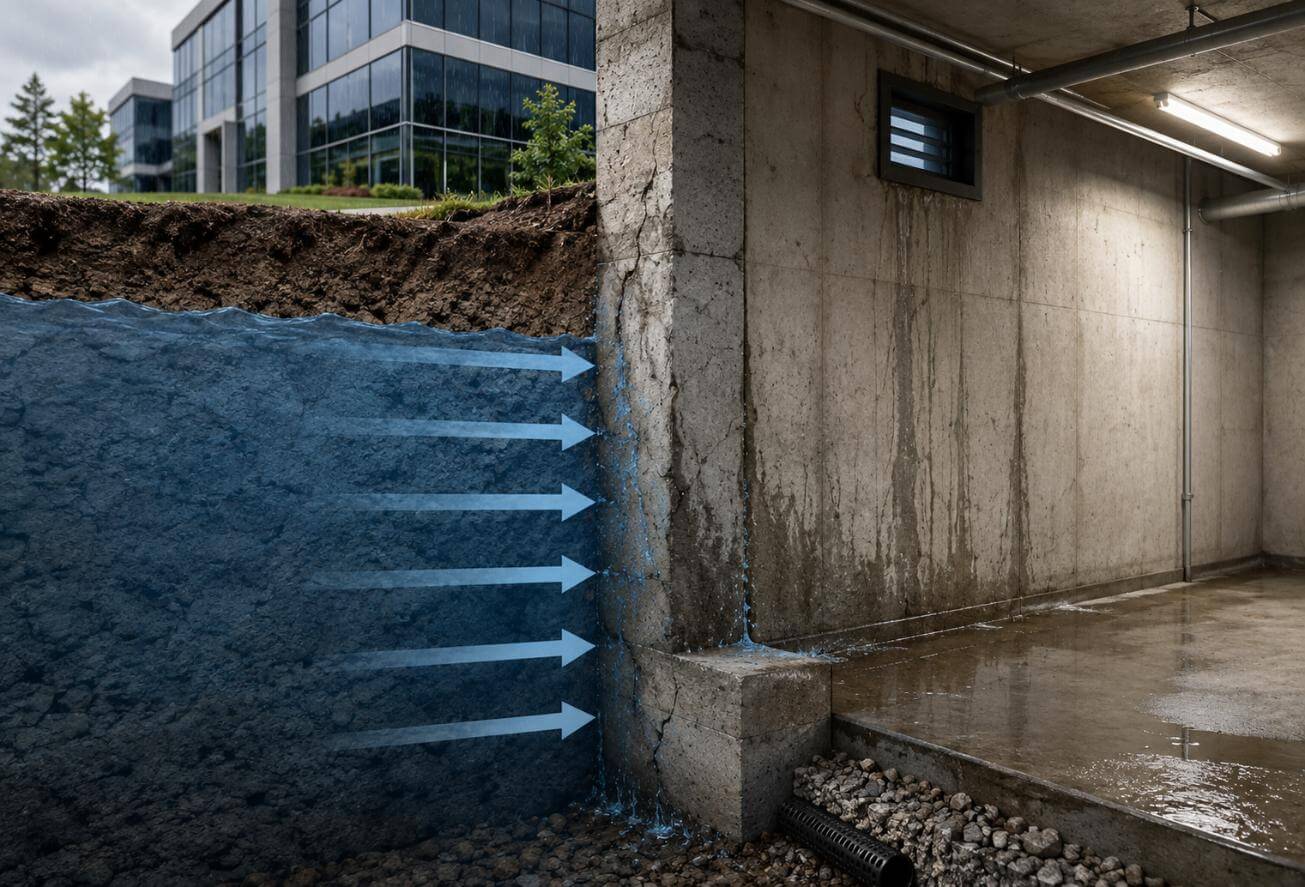
Water in a commercial basement does not always begin with a visible plumbing leak or obvious foundation failure. In Indianapolis, water can build up in the soil around below-grade walls and slabs after periods of rain or snowmelt, creating hydrostatic pressure that pushes moisture toward vulnerable points in the building envelope.
Quick answer: Hydrostatic pressure develops when water accumulates in the soil surrounding a below-grade foundation. As pressure increases, water can enter through cracks, joints, penetrations, porous masonry, and other weak points. For commercial buildings, the resulting damage may affect finished spaces, stored materials, mechanical equipment, indoor conditions, and day-to-day operations.
What Indianapolis property owners should know
- Hydrostatic pressure can exist even when there is no standing water visible outside the building.
- Indianapolis receives precipitation throughout the year, so below-grade water management is not strictly a springtime concern.
- Older commercial properties in areas such as Downtown Indianapolis, Broad Ripple, and Irvington may have below-grade assemblies that deserve careful inspection when moisture symptoms develop.
- Gutters, downspouts, grading, exterior drainage, foundation conditions, and below-grade waterproofing can all influence how water behaves around a commercial foundation.
- Repeated dampness, staining, efflorescence, or seepage should be investigated rather than treated only as a cosmetic problem.
Why Does Hydrostatic Pressure Matter for Indianapolis Commercial Buildings?
Hydrostatic pressure matters for Indianapolis commercial buildings because the region receives substantial precipitation across the year, creating recurring opportunities for surrounding soil to become saturated. When water cannot drain away efficiently, pressure against below-grade walls and slabs can rise and expose weaknesses that remain unnoticed during dry conditions.
National Weather Service climate normals for Indianapolis show average annual precipitation of 43.63 inches, with April, May, June, and July each averaging more than four inches. That rainfall pattern means commercial property owners in Marion County need to think about below-grade moisture as an ongoing building-envelope concern, not just a response to a single storm.
Properties near Downtown, Fountain Square, Meridian-Kessler, and other established parts of the city can vary considerably in age, foundation construction, drainage design, and previous modifications. Those differences affect where water travels and how moisture problems appear.
Knauss Property Services, LLC helps property owners address building maintenance and repair concerns. When we evaluate water-related damage, the goal is to understand where the moisture is coming from and what conditions are allowing it to affect the property.
What Does Local Weather Data Tell Property Owners About Water Exposure?
Local weather data shows that Indianapolis receives meaningful precipitation in every season, with a 1991-2020 annual normal of 43.63 inches according to the National Weather Service. Average precipitation is highest in June at 4.95 inches, followed by May at 4.75 inches, reinforcing why drainage and below-grade moisture management deserve attention around commercial properties.
Year-to-year totals can also vary considerably. National Weather Service records show 43.53 inches of precipitation at Indianapolis International Airport in 2024 and 36.70 inches in 2025.
A lower annual total does not eliminate hydrostatic-pressure concerns. What matters at a particular building includes rainfall timing, drainage capacity, soil saturation, grading, foundation construction, and the condition of waterproofing and drainage components.
How Can Hydrostatic Pressure Affect a Commercial Property?
Hydrostatic pressure can affect a commercial property by forcing moisture through vulnerable below-grade materials and openings, potentially damaging finishes, stored goods, equipment, and occupied spaces. Persistent moisture can also turn a seemingly minor basement problem into a recurring maintenance issue that disrupts how the building is used.
For Indianapolis businesses, the consequences depend heavily on what occupies the below-grade area. A basement containing inventory has different exposure than one containing mechanical systems, offices, archives, or tenant storage.
Water can also migrate beyond the first visible wet spot. Damp drywall, flooring adhesives, insulation, wood components, and other moisture-sensitive materials may require attention after repeated exposure.
Finding the source matters because replacing damaged finishes without addressing water entry can leave the underlying problem in place.
What Are the Warning Signs of Below-Grade Water Pressure?
Warning signs of below-grade water pressure include seepage at wall-floor joints, recurring damp spots, mineral deposits, foundation cracks, musty conditions, and damage that appears after wet weather. Commercial property managers should pay particular attention to symptoms that repeatedly return after rainfall or seasonal snowmelt.
Common signs include:
- Water appearing where a foundation wall meets the floor slab
- Damp patches or staining on below-grade walls
- White, powdery mineral deposits on masonry
- Peeling paint, bubbling coatings, or deteriorating finishes
- Cracks that show evidence of moisture movement
- Musty odors or persistently humid basement conditions
- Damaged flooring, drywall, baseboards, or stored materials
- Recurring seepage after heavy rain
One symptom does not automatically identify hydrostatic pressure as the cause. Plumbing, roof drainage, condensation, surface runoff, and other sources can produce similar evidence, which is why diagnosis should come before repair.
When Should an Indianapolis Property Owner Call a Professional?
An Indianapolis property owner should call a professional when below-grade moisture is recurring, entering through cracks or joints, damaging building materials, threatening equipment, or resisting basic drainage corrections. Immediate attention is especially appropriate when water is actively entering occupied, storage, electrical, or mechanical areas.
Property managers can safely monitor exterior grading, accessible gutters and downspouts, and the timing of moisture symptoms. Documenting where water appears and whether it follows rainfall can also help during an inspection.
DIY troubleshooting should stop when determining the source requires opening assemblies, repairing structural components, working around electrical hazards, or installing a below-grade water-management system. Commercial properties can involve interconnected drainage and building-envelope conditions that are difficult to diagnose from the wet interior surface alone.
What Common Conditions Contribute to Hydrostatic Pressure?
Common conditions contributing to hydrostatic pressure include saturated soil, poor surface drainage, ineffective downspout discharge, failed waterproofing, foundation openings, and inadequate below-grade drainage. Around Indianapolis commercial buildings, several of these conditions may work together rather than one single defect causing the entire problem.
1. Saturated soil: Extended or heavy precipitation can increase the amount of water surrounding below-grade walls.
2. Poor grading: Ground that directs runoff toward a building can increase the amount of water reaching the foundation.
3. Roof-water discharge: Gutters or downspouts that release large volumes of water near the structure can concentrate moisture where it is least desirable.
4. Foundation cracks and joints: Water under pressure tends to exploit available paths, including cracks, penetrations, seams, and wall-floor joints.
5. Aging waterproofing: Existing below-grade protection can deteriorate or become less effective over time.
6. Drainage limitations: A drainage system that is damaged, blocked, absent, or insufficient for current conditions may allow water to remain against the foundation.
How Can Commercial Buildings Reduce Below-Grade Water Problems?
Commercial buildings can reduce below-grade water problems by controlling roof runoff, maintaining positive drainage away from foundations, inspecting vulnerable below-grade areas, and repairing water-entry points appropriately. Preventive attention is particularly valuable before and during the wetter spring and early-summer periods common in central Indiana.
Property managers can periodically check accessible gutters, downspout outlets, exterior grading, drains, and visible foundation surfaces. After significant rainfall, below-grade areas should also be inspected for new staining, dampness, odors, or active seepage.
Keeping maintenance records can reveal patterns that a single inspection misses. If the same corner becomes damp after several rain events, for example, that history provides useful diagnostic information.
Interior sealants or coatings should not automatically be treated as substitutes for identifying why water is reaching the foundation.
What Results Should Property Owners Expect From Water-Damage Repairs?
Property owners should expect effective water-damage work to address both damaged materials and the conditions contributing to moisture exposure. The exact solution depends on the building, the source of water, the condition of the foundation, and whether drainage or waterproofing deficiencies are involved.
Some situations may involve localized repairs. Others may require broader drainage, waterproofing, foundation, or restoration work.
The realistic goal is to identify the water pathway, correct appropriate contributing conditions, and repair affected building materials based on their condition. An inspection is generally more useful than assuming every wet basement needs the same solution.
What Mistakes Make Commercial Water Problems Worse?
The mistakes that make commercial water problems worse are usually those that hide symptoms without addressing moisture movement. In Indianapolis, where precipitation occurs throughout the year, temporary cosmetic fixes can fail when the next period of saturated conditions exposes the same vulnerable area.
Mistake: Painting over a damp wall.
Consequence: The finish may blister or deteriorate while the moisture source remains.
Better approach: Determine why the wall is becoming wet before refinishing it.
Mistake: Assuming every wet spot is a plumbing leak.
Consequence: Exterior drainage or foundation problems may go unaddressed.
Better approach: Compare moisture events with rainfall and inspect possible interior and exterior sources.
Mistake: Ignoring small recurring seepage.
Consequence: Repeated wetting can affect a larger area over time.
Better approach: Investigate recurring moisture before replacing finishes.
Mistake: Repairing interior damage first.
Consequence: New materials may be exposed to the same water pathway.
Better approach: Diagnose and address the moisture source as part of the repair plan.
What Is a Common Indianapolis Commercial Water-Damage Scenario?
A common Indianapolis commercial water-damage scenario begins with a below-grade room that appears dry most of the year but develops dampness after periods of substantial rainfall. Water first appears along a wall-floor joint or foundation penetration, then staining and finish deterioration become more noticeable after repeated wet-weather events.
This is a representative scenario, not a Knauss Property Services, LLC case study.
A property manager might initially clean the area and assume the problem has passed. When moisture returns, however, the pattern suggests that investigation should extend beyond the visible interior damage. Roof drainage, exterior grading, foundation conditions, and below-grade water management may all need to be considered.
What Services Can Help Address Below-Grade Water Damage?
Services that help address below-grade water damage depend on whether the underlying problem involves drainage, waterproofing, damaged building materials, foundation openings, or a combination of conditions. The best repair scope starts with determining what failed and which materials have been affected.
Our approach is to help commercial property owners understand the visible damage and the conditions surrounding it before appropriate repairs are planned. Because every building differs, the recommended work should reflect the actual property rather than a one-size-fits-all assumption.
Request an evaluation of recurring below-grade water damage at your commercial property
How Do Short-Term and Long-Term Water Solutions Compare?
Short-term water solutions primarily manage immediate symptoms, while long-term solutions focus on reducing the conditions that allow recurring water entry. For Indianapolis commercial properties with repeated seepage, source-focused repairs generally provide a more useful strategy than repeatedly restoring the same damaged finishes.
Cleaning water, moving inventory, drying an area, and removing badly affected materials may be necessary after an incident. Those actions manage consequences.
A longer-term approach examines drainage, runoff, foundation openings, waterproofing, and other potential pathways. Professional evaluation becomes especially valuable when the source is unclear or multiple conditions appear to be contributing.
What Areas Around Indianapolis Can Experience Below-Grade Moisture Problems?
Below-grade moisture problems can occur throughout Indianapolis and surrounding Marion County wherever commercial buildings have basements, lower levels, foundation walls, or other below-grade spaces exposed to wet soil. Building age, drainage, construction, maintenance history, and site conditions matter more than a particular neighborhood name.
Properties in Downtown Indianapolis, Broad Ripple, Irvington, Fountain Square, and nearby communities such as Carmel and Greenwood can all face water-management concerns depending on their individual sites and construction.
What Can Happen If Recurring Water Intrusion Is Ignored?
Ignoring recurring water intrusion can allow damage to spread to additional finishes, stored property, and building components while making the original moisture source harder to overlook. For a commercial property, waiting can also mean dealing with repairs during business hours or after water reaches a more sensitive area.
Recurring seepage deserves attention even when each individual event appears minor. A small amount of water entering after several storms is evidence of a repeatable pathway.
Addressing that pattern early can help property managers make planned repair decisions rather than waiting for a more disruptive wet-weather event.
Frequently Asked Questions About Hydrostatic Pressure in Indianapolis
What is hydrostatic pressure around a commercial foundation?
Hydrostatic pressure is the force water exerts when it accumulates in soil around or beneath below-grade building components. As surrounding soil becomes wetter, water can press against foundation walls and slabs and move through available cracks, joints, penetrations, or porous materials.
Is hydrostatic pressure common after heavy rain in Indianapolis?
Hydrostatic-pressure conditions can become more noticeable after heavy or sustained rain because additional water can saturate soil around a foundation. Indianapolis has a 1991-2020 annual precipitation normal of 43.63 inches, according to the National Weather Service, so managing rainfall around commercial foundations is a relevant year-round maintenance concern.
Can water enter an Indianapolis commercial basement without a large foundation crack?
Yes. Water can enter a commercial basement through small cracks, wall-floor joints, penetrations, porous masonry, or other vulnerable locations. A dramatic visible crack is not required. Recurring dampness or seepage after rain can justify further investigation even when the foundation appears relatively intact.
Why does water appear where the basement wall meets the floor?
Water may appear at the wall-floor joint because that connection can provide a pathway when water pressure develops around or beneath the structure. The exact cause still needs to be evaluated because plumbing leaks, surface drainage, foundation conditions, and other moisture sources can sometimes produce similar symptoms.
What time of year should Indianapolis property managers watch for foundation seepage?
Indianapolis property managers should remain alert throughout the year but pay particularly close attention during wetter periods and after heavy rain or snowmelt. National Weather Service normals show April through July as relatively wet months, with each averaging more than four inches of precipitation.
Can gutters contribute to below-grade commercial water problems?
Yes. Gutters and downspouts can contribute when roof runoff is deposited too close to a foundation or drainage components are not functioning as intended. Because commercial roofs can collect substantial runoff, directing that water appropriately is an important part of evaluating recurring foundation moisture.
Should I seal a leaking basement wall from the inside?
Interior sealing may be appropriate in some circumstances, but it should not automatically replace diagnosing the source of water. If saturated soil, poor drainage, a foundation opening, or another exterior condition is contributing, simply covering the interior symptom may not address why moisture keeps returning.
When should a Marion County commercial property be inspected?
A Marion County commercial property should be evaluated when seepage repeatedly follows rain, water threatens electrical or mechanical equipment, materials are deteriorating, or previous repairs have not stopped the problem. Documenting the timing and location of moisture can help make the inspection more informative.
Protect Your Indianapolis Commercial Property From Recurring Water Damage
Hydrostatic pressure can remain invisible outside a building until moisture finds a path indoors. Understanding the relationship between rainfall, drainage, foundations, and below-grade materials gives Indianapolis property owners a better basis for addressing recurring water damage before simply replacing what got wet.
Stop Recurring Water Damage at the Source
We can help you evaluate water-related property damage and determine an appropriate path toward repair.